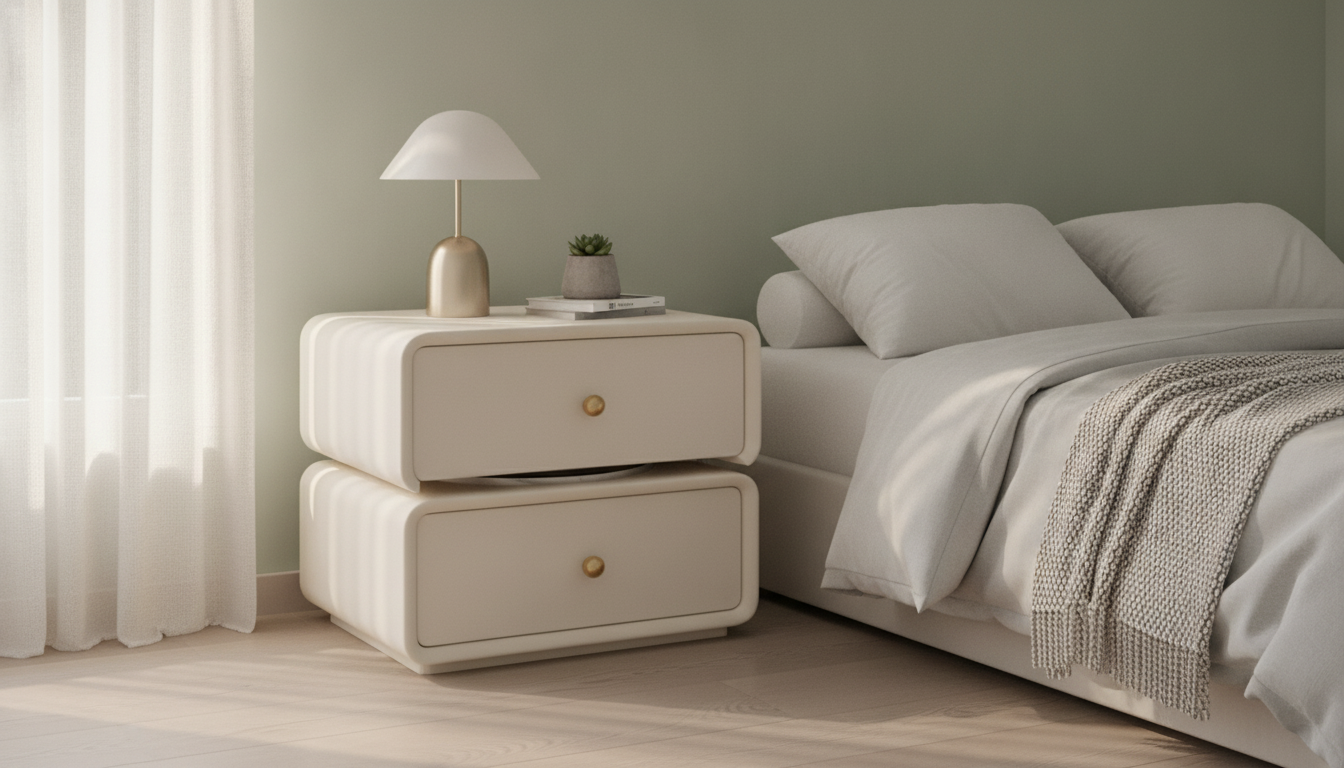
A rotating bedside table with drawers keeps essentials close while letting the surface pivot toward the bed, chair, or doorway. This style suits compact bedrooms, corner layouts, and anyone who wants flexible access to a lamp, book, charger, and hidden storage—without adding visual clutter.
The standout feature is movement: instead of a fixed top that forces you to reach, the table’s rotating top (or rotating body) swings closer to where you’re sitting or lying. That simple shift can make nightly routines easier, especially in tight rooms where every inch counts.
Rotating nightstands vary widely in how they feel day to day. A good one turns smoothly, stays stable when extended, and offers drawers that don’t stick once they’re filled.
| Feature | Why it matters | What to verify |
|---|---|---|
| Rotation | Better reach and flexible placement | Angle range, smoothness, no wobble at full extension |
| Drawers | Clutter-free top surface | Interior dimensions, glide type, stop mechanism |
| Stability | Safer daily use | Base width/weight, levelers, anti-tip options if needed |
| Materials/finish | Durability and easy cleaning | Scratch resistance, wipe-clean surface, edge banding quality |
| Assembly | Less hassle and fewer squeaks | Pre-drilled holes, clear instructions, included hardware |
Because the top can swing toward different “zones,” a rotating bedside table often replaces more than one small piece of furniture.
Rotating furniture rewards a little planning. The goal is comfortable reach without bumping walls, bed frames, or trim when the top swings.
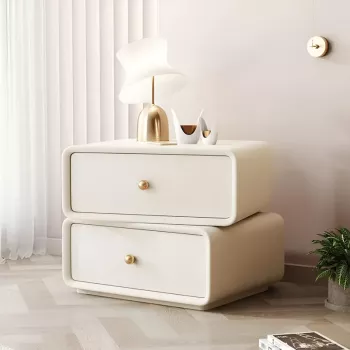
If the main goal is maximum flexibility, a full-rotation design can be a strong fit for small rooms and multi-use corners. The 360° Rotating Bedside Table with 2 Drawers is built to swivel for reach from different positions while still offering concealed storage.
For bedrooms that double as a lounge or media space, pairing a streamlined nightstand with a larger storage piece can reduce visual noise. The Boho-Chic Oak Wood TV Stand with Storage for 75+ Inch TVs offers enclosed storage that can help keep extra cords, devices, and linens out of sight.
If you’re comparing materials, it can also help to understand composite-wood emissions compliance (especially for enclosed bedrooms). The California Air Resources Board (CARB) Composite Wood Products program outlines standards commonly referenced for indoor furniture materials.
It can, as long as the base is wide or weighted and the table sits level on the floor. Stability improves when heavier items stay closer to the center, since overloading the outer edge can increase wobble when the top is fully extended.
Plan the swing path like a half-circle (or full circle if you want 360° access) and make sure it clears the bed frame, wall trim, and nearby furniture. Also account for drawer-opening space so handles and drawer fronts don’t collide when the top is rotated.
Keep the top for the few items you reach for daily—like a lamp, phone, and a small tray—so it stays easy to use and clean. Put cables, remotes, meds, and personal items into drawers by category to reduce visual clutter and simplify your nightly routine.











Leave a comment